Showing posts with label athlete. Show all posts

Saturday, October 5, 2013

(UPDATED) Friday Feature: Neil Peart of Rush

I while back, I posted about Neil Peart, expressing my respect for him as a person, even if I have been slow to fall in love with his playing and the music of Rush.

This past week I discovered an article on www.drummagazine.com talking about the new album, "Clockwork Angels." The article is absolutely worth reading in its entirety, but there are two points that immediately struck me.
  1. Neil Peart considers himself an athlete. As such, he trains his entire body with intense cardio, stretching and yoga, as well as strength training and weight-lifting. He specifically targets areas where drummers commonly have injuries - such as shoulders and elbows - to prevent an injury to  himself. This, in my opinion, is one of the key reasons he continues to innovate and play at the highest level in Rush's fourth decade.
  2. To quote the article directly, "Master Player = Master Student" Peart is one of the great examples of someone who is never satisfied or complacent with their playing. Repeatedly over the course of his very long, illustrious career, Peart has, "surrendered," to great (and I do mean great) teachers who have helped take him to the next level. 
To summarize, treat your body as well as you can, and always be learning. Could it really be that simple?

Neil Peart continues to earn my respect as a human being, and my love of his playing, lyrics and the music of Rush are constantly growing. 

Thank you, Mr. Peart. You're worthy of your rock star and idol status!


Here is the original post:

Friday Feature: Neil Peart of Rush

You know how tall people always get asked if they play basketball? I have twin cousins who are 6’6”, and they do not play basketball, nor do they want to. They humor people all the time who ask the question, and privately want to slap them silly. 

Well, it’s like that for drummers, too. The minute somebody finds out you play, they’re all, “So, hey, what about Neil Peart, huh? You must love Rush, right?” I’m the kid who deliberately avoided all things Rush and Peart for years. No, decades. Religiously, you might say.* 

Up until a couple of years ago, I loved fantasizing about witty remarks I could reply with, but always said something like, “Oh, yeah, well you have to love him/them, right? Great stuff. Yeah, big fan.”

So, here’s the thing: I finally read an interview with Neil. After his first wife died in 1998, he spent an entire year riding a motorcycle around North America, and wrote a book about it - his fourth. The interview, and subsequent other articles I read, revealed Peart as a highly intelligent, well-rounded person, as well as being one of the most respected and emulated musicians of the modern era. I remember being impressed with him as a person, not as a musician

Somehow, for me, that opened my ears - and my mind - to the music of Rush. Had I my life to do over, I would have taken that album the first time it was offered, not the 28 billionth. I can’t say that I’m a huge fan, not yet, anyway, but I have finally become an appreciateur, if you will, of Neil Peart and Rush. They take the creation of their music, and musical expression, very seriously. I respect them a great deal, and am coming to know more of their repertoire.

For those of you who have yet to get to know Neil Peart, allow me to suggest a starting point, although I’m probably the only one of his fans who would recommend it. Start with his instructional video, “A Work in Progress.” It’s pretty recent, so it’s thirty or so years into his career, and he talks about reinventing himself. Awesome. That I love.

Happy discovering!

*The way I also avoided the Beatles until about a year ago, I might add. I’m a fool’s fool, so to speak, because I’m now a dedicated student of the Beatles. Wish I had come to them sooner.

Monday, February 18, 2013

What is "headroom?"

For one year in high school I drove an old Dodge pickup truck. I loved having a pickup but hated having to drive it anywhere. It had a worn-out engine and a pathetic transmission. Its top speed was 60 miles per hour, no matter what. You could have dropped that thing off a cliff and it wouldn't have gone any faster!

So when I had to drive two miles on the freeway (where the speed limit was 75) on my way to school every morning, it was torturous, to say the least. The truck would shake and scream, and generally threaten to come apart at every possible point. My friends would pass me in their nicer cars, and I would try not to make eye contact. It was stressful and embarrassing. Honestly, it was all I could do to keep that thing on the road. Needless to say, driving wasn't very fun, and I didn't feel very good at it.

Early one morning I was on my way to school and wrecked the truck. It had snowed the night before, then cleared, so there was black ice on the road. The accident totaled my truck, and probably should have taken my life. It was one of the scariest moments of my life.

When I got back to driving, I (luckily) was able to borrow my mom's car, a late model sports sedan. To give you some idea of the capabilities of this car, let me make one comparison to the truck. My old truck's speedometer went to a maximum of 85, and that was wishful thinking. Mom's car? Its top mark read 140, and in all the time I drove it I never came close to challenging that mark, or had reason to doubt that the car could reach it.

That car totally changed me as a driver. I no longer had to fight the vehicle or worry that I was going to destroy it just by driving it on the freeway. My driving "style" became much more consistent and relaxed. I wasn't worried about driving anywhere - the freeway, on a hill, etc. Driving became fun.

Among all the differences between the car and truck, the fundamental one was headroom. What is headroom? In a nutshell, it's the difference between what you must do and what you can do.*

Here are a few examples of how the term headroom is used various settings.
  • If I have the strength to lift 100 pounds, but only have to lift 50, I have headroom. 
  • If a DJ has a sound system with 5000 watts of power, but only needs 1000 watts to play in a certain space, s/he has headroom. 
  • If you need to drive 75 MPH on the freeway but the car can go 140, you have headroom.
How does this relate to music and to drumming? 

Essentially, we're all trying to develop headroom in our playing as we continue to practice and learn as much as we can. Think of it like the car. If the band you're playing in is asking your "engine" - your skill set - to go 80 miles an hour, and you can only go 80, then every time you play you're maxing yourself out. This is usually neither comfortable nor fun.

But if they're asking you to go 80 and you have the ability to do 120, then you can do what you need to do with style, and have bursts of "speed" when they're appropriate. More than that, you have the strength and "chops" to play what you hear in your head. And that, my friends, is fun

I'm not saying that you should never push your limits or live on the edge a little bit. But think of it another way: If we're talking about athletes, you need a basic ability to keep up with your competition, but headroom is what allows you to make the extra play or effort to win the game. 

In another post I'll give you a direct example from my own drumming career, but for now, think about headroom. How much do you have, and what are you doing to increase it? 

One last thought. At a certain point, you'll have an "engine" that is capable of getting off the streets and getting into the big leagues. 

Yeah. Let's do THAT.

*It's actually a construction term that refers to the height of a doorway or the ceiling over stairs. It literally means the distance between the average person's head and the point where they would hit said head. This is why, when the average American stands under six feet, the ceiling is generally at least eight feet high.

Monday, August 13, 2012

The Technique Dilemma

Technique. What is it, anyway? Simply put, technique for percussionists boils down to a couple of things. How do you hold the stick or mallet, and how does it move? How do you approach the instrument or the pedals, etc?

For other instruments, there are other issues, but the bottom line is that there are ways to play that work and keep you safe (free from injury, etc.) and those that will keep you from achieving your potential or are flat out going to cause you injury*. Now, the technique itself is a topic for many, many other blog posts, so we'll just take a look at whether or not your technique actually matters all that much.

So, here's the scenario. Imagine that you are a baseball coach. You have filled all of your positions but one, and you are down to two possible players. Everything is equal between the two players except for one thing - their running technique. They both make the sprint from home to first in the exact same amount of time, but their technique couldn't be more different.

Player A has flawless running technique. The gait is smooth, footfalls are perfect, etc. The running is a thing of beauty. Player B, however, runs like a pregnant yak - nothing looks right and the motions are awkward.

It's up to you, Coach. Who do you choose?

If you're lazy or impatient, you choose Player A. But if you're a teacher and can help Player B improve their running technique, the speed will increase. Theoretically, if Player A may already be running as fast as possible, but Player B can only get faster - maybe much faster.

So, what does that mean for drummers? It's simple - good technique unlocks your potential. Conversely, like the baseball player in our example, bad technique may be slowing you down.

Honestly, I get tired of young musicians who say, "It's just how I play." Or, they'll tell their band teacher (who's a sax player or something), "Well, my friend's older brother is a real drummer, and this is how he said to do it."

You know what both of those statements translate into? "I'm lazy. It's too hard for me to do it right, so I'm just going to make excuses and not try."

Now, I'm not saying there aren't successful players with, shall we say, interesting technique. There are some variations between every single player because we're not all carbon copies of each other. But, if you carefully study the top drummers in the world, you'll notice that almost all of them - while they may not look exactly the same - are applying the same technical concepts. In other words, the main ideas are the same.

To continue the baseball example, no two throwing motions are the same, but you're not seeing anybody pitch underhand. If you wanna play baseball at the highest levels, underhand simply won't work. You also won't see people use techniques that are too far out of the norm. Athletes know that there are motions and practices that will hurt them, and those that won't.

*It's crazy how little most drummers know about their own bodies, in terms of muscles, joints, bones, ligaments and tendons. Think about how many strokes you play in an average practice session - thousands! And yet athletes, who may only shoot a few baskets in a game or throw several dozen pitches over a few innings, take great care to warm up, stretch, use proper technique, cool down, ice and strengthen all of the parts of their bodies that they use. 

Saturday, June 16, 2012

The Gig Log: Ragnar Wasatch Back

I remember the first time I ever saw the word "Ragnar" on the back of a vehicle. It concerned me slightly that after my first sighting, I caught it probably fifteen more times that day. Wasn't sure if I was seeing a new gang sign or was missing out on the coolest thing since sliced bread. Turned out it really was the sliced bread thing.

Anyway, fast forward a couple of years, and I played a gig with the band Lokalgrown at the finish line party at the Wasatch Back, part of the Ragnar Relay series.

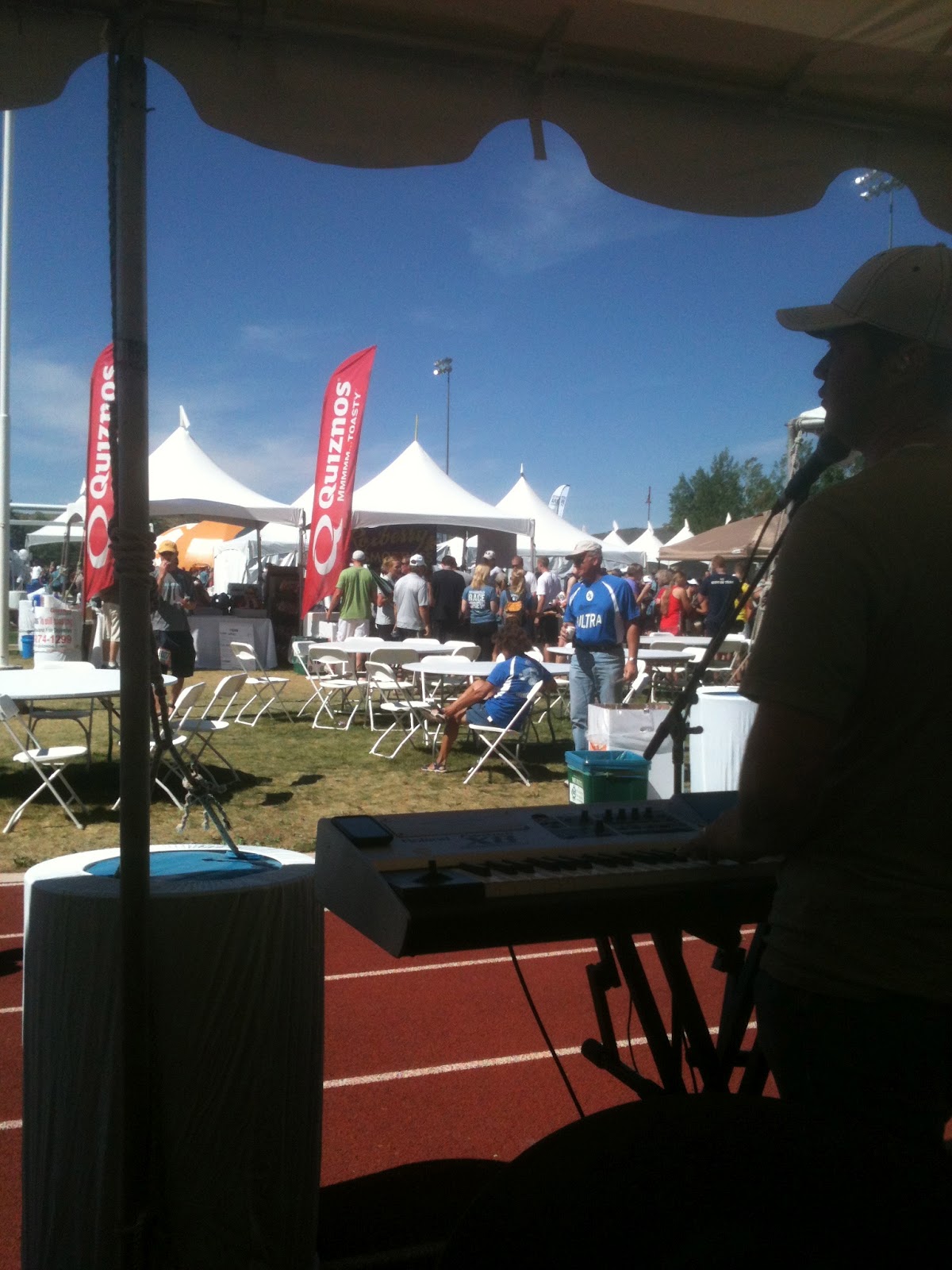
The view from my seat.
Honestly, there's not much to say about the gig. We were in a tent, had a small but enthusiastic crowd, and played nearly non-stop for four hours. (As a side note, I'm getting more comfortable with my V-Drums, which is a very good thing.) The actual playing was a blast. Very fun gig.

But the best thing about this gig was the people we got to interact with. All these Ragnarians, people who had spent the last thirty or so hours pushing themselves to their physical and mental limits. Some looked absolutely exhausted, and some still had the energy to dance and party it up with us.

One of the hallmarks of most Ragnar teams is crazy outfits, themes and matching shirts. A couple of my favorite sightings from today are, "Half Fast," and "It's my Ragnar and I'll cry if I want to!" We also saw lots of Superman, Wonder Woman, Speedo, cartoon and movie characters, fairies, pink beanies, wigs, Harden's beards, tutus and spandex.

The driver's seat, as it were.
For me, I was very inspired by the people I saw. Some looked like stereotypical athletes, but very many of them were average people - men and women who took the challenge of the race to push themselves out of their everyday life and into a place where they could become better and stronger. Man, I admire that.

I hope I get the chance to run a Ragnar Relay. I know that my physical fitness will benefit, but I also believe that my ability to handle life and music will improve, as well. You and I can both do hard things, and we should.

Run hard. Play harder.

Why musicians should watch the big game (Seriously!)

Photo by  Ameer Basheer  on  Unsplash Here we are, about to watch another televised wrestling match over who puts a football on one en...