Showing posts with label v-drums. Show all posts

Monday, June 17, 2013

V-Drums from a sound engineer's perspective

A few days ago I got a last-minute call to engineer front-of-house sound for a local band at a fairly high-level corporate event. Their drummer used the Roland TD-9 kit on this particular gig.

It's worth noting that the room was about about the size of half of a basketball court, with high ceilings and real wood paneling on all of the walls, and that the sound system consisted of Mackie's DL 1608 iPad-based mixer, and their DLM series powered speakers (more on the Mackie gear in another post). I was able to mix from all over the room with my iPad, so I got the full-range perspective on the band's - and each individual player's - sound.

Here are the bullet points:

  • Individual drum and cymbal sounds were fine. In the context of the mix, they actually sounded a lot cleaner than many acoustic kits I've mixed. 
  • I absolutely hated not being able to adjust the volume of the individual parts of the kit. During sound check I asked the drummer to manually turn up the kick drum on the TD-9's brain. That helped, but once the show started I basically had no way to deal with imbalances. 
  • Likewise, any EQ, effects or other manipulations happen across the entire kit. You can't do anything to the snare drum (or kick, toms, etc.) without it affecting the entire kit. 
  • We were able to quickly adjust the pitch of one of the toms - again, on the brain - to eliminate a sympathetic vibration without drastically affecting the overall sound of the drum and kit. This happened in seconds, rather than the several minutes (or longer) it would have taken to similarly adjust an acoustic drum. 
In the long run, I'm sure that a good engineer and drummer would be able to dial in the sound they need from a particular room very effectively, but the aforementioned frustrations kept me from feeling like I had achieved the best sound possible in the situation. 

As expected, the major benefit of the V-drums in this situation was the low stage/house volume. Especially for corporate and casual events, volume levels can be a very big problem. The drummer also effectively used many electronic sounds that would have been impossible on an acoustic kit. 

As technology improves, it will become more and more common for electronic percussion instruments to be integrated into all kinds of performances. I will continue to explore their application, benefits and drawbacks as the opportunities present themselves. 

Happy drumming!

Tuesday, July 10, 2012

Transitioning to V-Drums: It can...and it can't

As I mentioned in an earlier post, I acquired a set of Roland V-Drums earlier this year, and I've been documenting my transition and trying to clarify the strengths and weaknesses of the electronic kit.

Let's start with a couple of "can'ts."

It can't give you realistic feel and response. Probably the most obvious weakness is the hi-hat pedal. When playing jazz, the hi-hat "chick" sound is all but worthless. Not only is the sound mushy as all get out, you have to absolutely crank the level (and drop everything else) to get an adequate relative level for swing and latin grooves.

If you can imagine the differences between a grand piano and an electronic keyboard, you're close - at least in concept. This is the way I've begun to think about it: with acoustic, real drums, you are limited by physics - by the literal wood, metal, plastic, metal and wood (I know I repeated metal and wood, but that was for effect) - and by your own skills and creativity. With the V-Drums, you're limited by the programming of the computer module and the capabilities of the triggers.

That being said, you really do have to think about acoustic drums and electronic drums as two very different instruments, and thus approach playing and making music differently. You might play them with similar technique, but they are as different as the aforementioned piano and keyboard.

And if you're thinking about them this way, you realize quickly that the number one strength of the electronic drums is that they have literally hundreds of sounds onboard. You can adjust - within limitations - the samples to reflect shell material, diameter and depth, as well as a limited bank of cymbal sounds. You can literally change kits every song - or every chorus if you want!

Another huge benefit is that you can play virtually silently. With headphones (I mentioned this before), I can rock out at 2 AM without waking the kiddos. And with an audio input jack, I plug in the ol' iPad and practice with a track and be almost totally silent. The feel is close enough that this is really a great benefit. It's not like you're going to have to make a huge adjustment when you go back to acoustics.

This, in fact, is one of the reasons I was encouraged to get a virtual kit - to keep the stage as quiet as possible during performances. Combined with in-ear monitoring, the only live sounds on stage are acoustic guitar and voices. It's eerie and cool at the same time. The bass, electric guitar and keyboard players all plug directly into the system, amp-less.

I do miss the "thump" of the live sounds. Even when using the in-ears, you can feel the vibration of the drums and amps, and I do miss that. But it is nice to be able to pull out one ear, and then have a relatively low-level conversation while playing a tune. It's gotten almost a little silly at some of the less intense (read: background music with zero audience) gigs because we're catching up and chatting it up on stage.

One last thing for now. This may seem backward, but I miss having to play with good dynamics. In a small venue, I used to have to choose my sticks and play so carefully so as not to overblow the band, and in a large venue I had to work pretty hard. Now, it's all in the hands of the engineer - I've even cut my stick bag down to one pair (minus the bag) when I take out the V-drums.

And that's just weird.

Anyway, enough of my rambling for now. As always, I welcome comments, opinions, input and feed back below.

Happy drumming!

Saturday, June 16, 2012

The Gig Log: Ragnar Wasatch Back

I remember the first time I ever saw the word "Ragnar" on the back of a vehicle. It concerned me slightly that after my first sighting, I caught it probably fifteen more times that day. Wasn't sure if I was seeing a new gang sign or was missing out on the coolest thing since sliced bread. Turned out it really was the sliced bread thing.

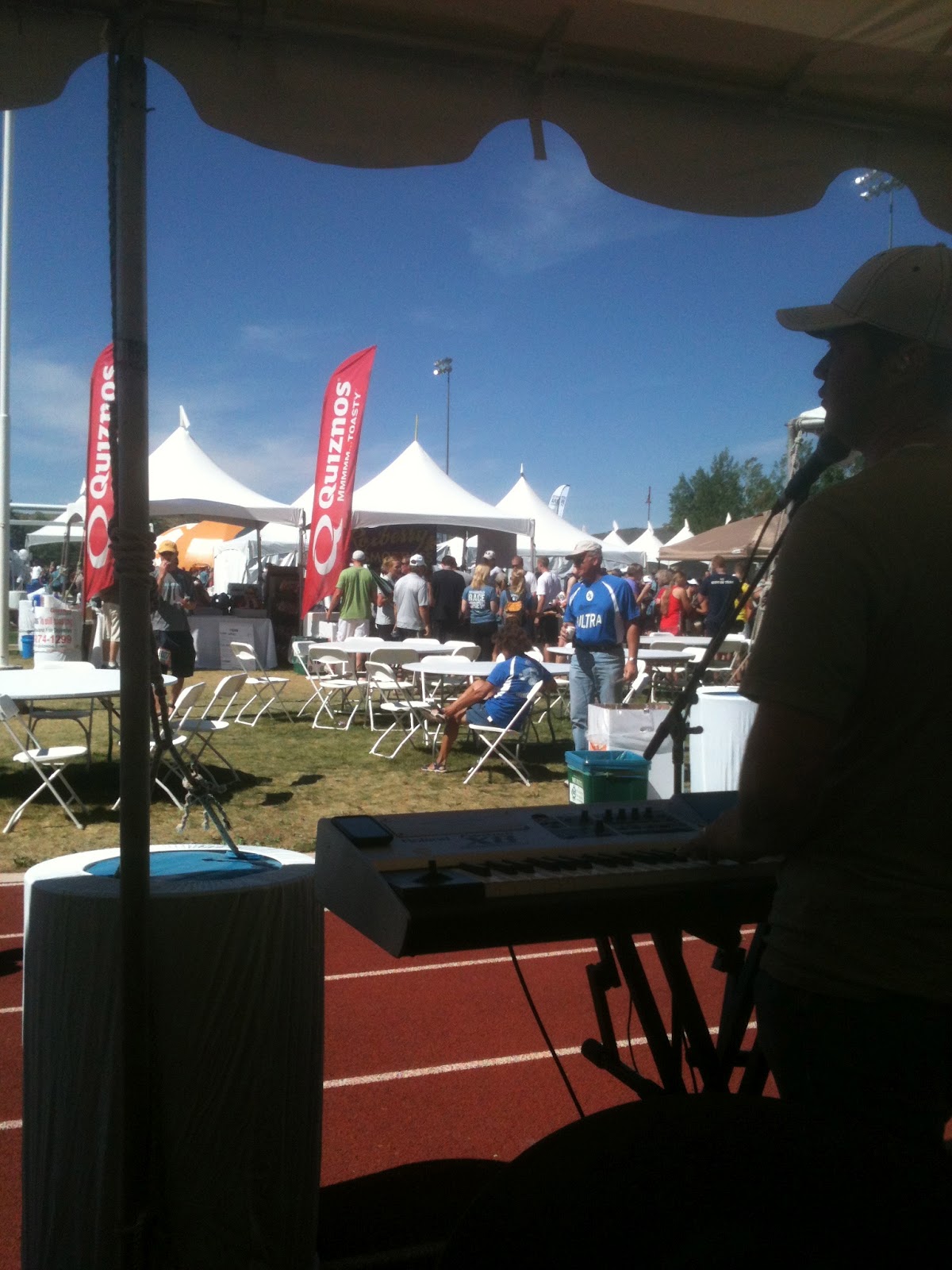
Anyway, fast forward a couple of years, and I played a gig with the band Lokalgrown at the finish line party at the Wasatch Back, part of the Ragnar Relay series.

The view from my seat.
Honestly, there's not much to say about the gig. We were in a tent, had a small but enthusiastic crowd, and played nearly non-stop for four hours. (As a side note, I'm getting more comfortable with my V-Drums, which is a very good thing.) The actual playing was a blast. Very fun gig.

But the best thing about this gig was the people we got to interact with. All these Ragnarians, people who had spent the last thirty or so hours pushing themselves to their physical and mental limits. Some looked absolutely exhausted, and some still had the energy to dance and party it up with us.

One of the hallmarks of most Ragnar teams is crazy outfits, themes and matching shirts. A couple of my favorite sightings from today are, "Half Fast," and "It's my Ragnar and I'll cry if I want to!" We also saw lots of Superman, Wonder Woman, Speedo, cartoon and movie characters, fairies, pink beanies, wigs, Harden's beards, tutus and spandex.

The driver's seat, as it were.
For me, I was very inspired by the people I saw. Some looked like stereotypical athletes, but very many of them were average people - men and women who took the challenge of the race to push themselves out of their everyday life and into a place where they could become better and stronger. Man, I admire that.

I hope I get the chance to run a Ragnar Relay. I know that my physical fitness will benefit, but I also believe that my ability to handle life and music will improve, as well. You and I can both do hard things, and we should.

Run hard. Play harder.

Saturday, June 9, 2012

Transitioning from acoustic drums to Roland's TD-9KX2-S

First gig on the new kit.
I've been playing drums for 23 years as of this fall. I've played all of those years on acoustic instruments.* So earlier this year when one of the bands I play for wanted me to go electric, I was skeptical, to say the least.

In this particular case, the goal was twofold. First, we wanted to reduce stage noise (we also transitioned to in-ear monitoring), and second, we wanted to have more sound options at the touch of a button. This particular band is very show-oriented - an entertainment band that primarily plays corporate and community events, with the occasional wedding.

About two months ago I gave in, bit the bullet and dropped two grand on a closeout model of the Roland TD-9KX2-S. Since then, I have played about 6-7 gigs on the kit, and it's been quite the adjustment. To achieve the goals of the band and also to get a full perspective, I'm using the kit as-is, straight out of the box. No substitutions (like cymbals or snare drums), no additions, and no modifications.

Still getting used to how it looks on stage.

To be fair, I wanted to get a few gigs into the new arrangement before I started blogging about it, so I've waited until now. At this point I feel like I'm starting to understand some of the strengths and weaknesses, so I'm going to be sharing my observations periodically and asking for feedback from other musicians.

Just to get started, here are two quick observations:


  • It's not the real thing. It's just not. After discussions with other players who use both acoustic and electric instruments, I've come to the conclusion that when I play V-Drums, I'm no longer a "drummer." I'm an, "electronic musician." I still play the role of drummer, but I have to realize that I'm not playing drums. I'm essentially playing a computer with a drum-like interface. 
  • Because it's not the real thing, the player is limited by the programming and the capabilities of the hardware. With real acoustic drums, you're limited by physics. One great example of this is the playing of shells, stick clicks, ping shots and cymbal harmonics. The programming simply will not support the natural acoustic responses of wood, metal and mylar.
My load out "stack."
If you have opinions, observations or suggestions for those of us venturing into the electronic side of drumming, feel free to share below. 

More to come...

*Okay, okay. I did own an earlier Roland V-kit for about a year, but it was used exclusively in a teaching studio where volume was a major issue. I think I did a one-song recording project on it for a friend, but that was it. All other gigs were on acoustic drums. I was so non-plussed with the kit that I sold it as soon as I moved out of that studio.

Why musicians should watch the big game (Seriously!)

Photo by  Ameer Basheer  on  Unsplash Here we are, about to watch another televised wrestling match over who puts a football on one en...