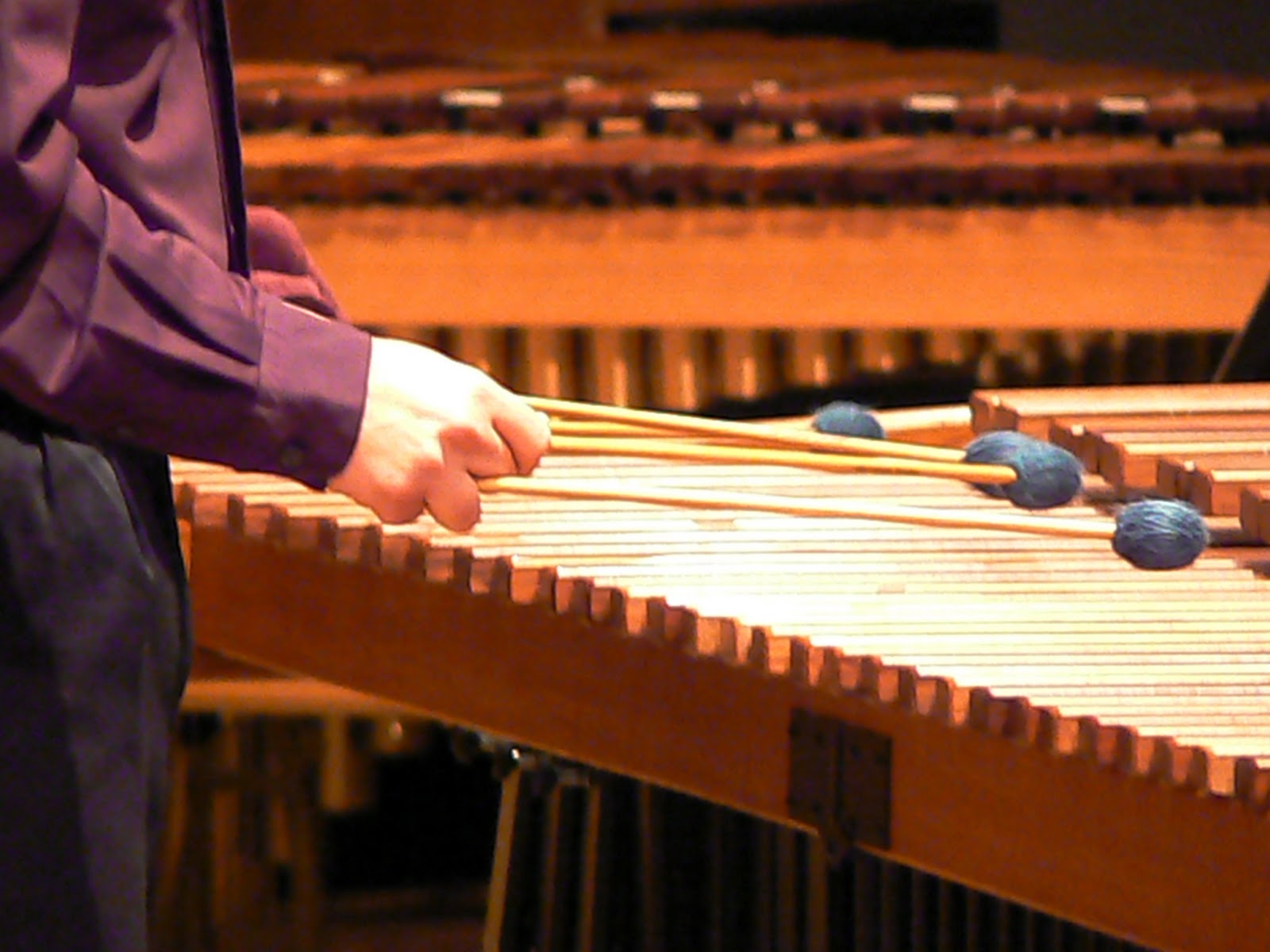
Showing posts with label marimba. Show all posts

Wednesday, November 6, 2013

Practice LESS. (Wait....what?)

Like all music majors, I performed solo recitals at the end of my junior and senior years in college. The experience of prepping for a recital is excruciating, and it feels like every waking minute is devoted to learning, cleaning and rehearsing every aspect of the performance.

Just a few weeks prior to my senior recital, I was seriously struggling with a difficult snare drum solo, and the stress was really getting to me. I was practicing no less than an hour and a half per day on just this one piece (in addition to hours on marimba, vibraphone, timpani, rudimental snare drum and drum set), and I was making very little progress. I was frustrated, and getting very desperate.

At my weekly lesson, I presented the problem to my instructor, Dr. Dennis D. Griffin. He suggested something that sort of blew my mind. It went something like this:

Dr. G: How long are you practicing this piece every day?

K: About ninety minutes, give or take.

Dr. G: And how long do you spend warming up - doing exercises and rudiments and the like?

K: About fifteen minutes.

Dr. G: Ok. Here's what I want you to do. Practice the solo less. Spend at least half of your time on technique exercises, things like the Stick Control book. Make sure you're using exercises that apply to the challenging aspects of the solo.

At this point I sort of freaked out.

K: Practice....less? But, Dr. G, I only have a few weeks until my recital! I just CANNOT give up the practice time on the solo.

Dr. G: Try it for just one week. Give it as much focus and determination as you can, and if it doesn't help you in one week, you can go back to doing it your way.

Needless to say, I felt pretty hopeless. How could I possibly make progress on the hardest solo I'd ever played in my life by practicing less? And a lot less, at that?

But the good Dr. Griffin had never led me astray before, so I took his advice and went to work. Over the next week I took apart the solo, broke it down to its elements, and found exercises (mostly out of the Stick Control book, using the slow-fast method as my approach) that applied to each element.

To cut to the chase, it worked. In that week, by practicing my solo for half of my normal time, I made more progress than I had accumulated up to that point. I made my recital deadline, and played the toughest piece of concert snare drum literature of my life - and played it pretty well!

Candidly, it would have been good enough just to make it through my recital, but here's the amazing part: the skills I worked on during that period of time have stayed with me to this day. They have become part of my vocabulary and remained at the tip of my fingers for use not only in formal concert settings, but in my improvising and drum set playing, as well.

There are probably more lessons here than I'm thinking about, but here's the one: Being a great musician is much more about having the skills to construct a variety of musical phrases, sounds and components, rather than knowing a piece or a collection of pieces. You've got to have a repertoire, for sure, but to continue to be expressive and adaptable, you must constantly be building a collection of musical tools.

Musicians often call this their, "toolbox," or, "bag of tricks."

Let's think about it another way.

Did you ever play with Lego's? Imagine if you only had one kind, size or color of Lego block. What could you build? Not much. You would have a limit on what shapes and functions you could construct out of one block.

But what if you had two, or five or a hundred? With every added type, shape, size of block, you exponentially increase what you can build, how it can function, etc.

One more comparison: Basketball. If you only have one move, your defender will easily stop you from scoring, and you'll be an ineffective - not to mention boring - player.

The same is true with your musical skills. If you don't have very many rudiments, sticking patterns, independence skills - even ideas - to draw from, you'll be limited, ineffective, boring, etc. More than that, you'll be frustrated.

Lego's, basketball and music all have this one thing in common - they're more fun when you're better at them. And you're better at them if you have more tools, tricks and skills.

So, long blog post, but short message: Practice less. You'll get more done, and you'll keep it longer.

Happy drumming!


Wednesday, February 29, 2012

Beyond the Kit: Visualization

This is a pretty wacky story, so buckle up.

My junior year of college I had the opportunity to go to Dallas, TX for PASIC. It was a fantastic experience - life changing, even. But it happened to fall two weeks before juries (and if you don't know what juries are, thank your lucky stars), and it meant no practice time for a week.

Those of us who went on the trip - five percussion majors and our percussion professor - were talking about ways to make up for the lost practice time, and one of my colleagues mentioned this foreign sounding word to me: visualization.


Visualization is basically this: seeing the instrument in your mind's eye, you rehearse the piece, section, or whatever it is without physically doing it. It took me some practice (no pun intended), but I was finally able to visualize a marimba keyboard and four mallets in my head. It started one note at a time, then a measure, then a phrase. The coolest thing about visualizing your practice is that there are no rules and no limits. You can sound perfect, play in an amazing venue, make no mistakes, etc.

Anyway, I tried it. On the flights, both ways. On the train. In the hotel room. At breakfast. And you know what? When we got back from Dallas, I had actually improved my playing without having touched a marimba or mallets for a solid week. 


It was nothing short of shocking.

If I had a little more discipline, I would have developed the habit of visualization and used it more frequently, but I have tried it over the years when I'm about to go on stage or start a take in the studio.

Now, I'm not advocating the abandonment of actual, real-life practicing, but try some visualization, especially when you're learning something new. This is a bit backwards, but I've always believed that if you can't think it, there's no way you're going to play it.

Happy drumming, and think happy thoughts!

Tuesday, February 7, 2012

Gear Up: Practice Marimba and Xylophone

Just got back from the UMEA Mid-Winter Conference. It was awesome! Among the many people I met and things I learned, I may have come across a solution for a dilemma I've been having.

How do I get a marimba for less than an arm and a leg? Once I get one, how do I keep it from taking up my whole house?

I'll be brief and let these products speak for themselves, but here are two I was able to get an eye on, and at least one of them is definitely going to be getting a new home at my house!

First, the Musser 3PM (3 Octave Practice Marimba):


And, the Adams 3-octave marimba and 3.5-octave xylophone:


I couldn't be happier to start seeing some lower-priced instruments for percussionists. If you're taking lessons from me, you can expect to see some of these instruments in my studio soon.

Happy practicing!

Thursday, January 26, 2012

A little marimba help, here!*

Okay, all my percussionist friends, here's the question.

What marimba mallets do you use and recommend? I'm trying to put together a list of mallets I can recommend for beginning and advanced marimba students.

Please leave a comment below telling which brands and models you use, and why you like them.

Thanks for the help!

*Milestone! This is the hundredth post on this blog. Thanks for helping me keep it going strong!

Wednesday, January 18, 2012

Beyond the Kit: Percussion Ensemble

The percussion ensemble, also known as percussion orchestra, is rapidly becoming a major player in the modern chamber music arena. The ensemble can be made up of anything you can hit, er....strike. Any struck instrument is technically considered percussion, so it's fair game. From traditional instruments to trash cans, boat propellors, car doors, flower pots, whatever.

A standard ensemble line up would include marimbas (4), vibraphones (2), xylophone, bells or glockenspiel, battery percussion (bass drum, snare drum and cymbals), timpani, chimes and a variety of auxiliary percussion such as triangles, shakers, tambourines and more.

The first percussion ensemble experience most of us get is in junior high or middle school, and - I'm not gonna lie - it's usually pretty bad. It's probably one of what we call "drummy drummy" ensembles where a bunch of 11 and 12 year olds bang on snare drums, bass drum, wood block and cymbals. Most of those pieces aren't very musical, and they aren't very fun.

Fortunately, percussion ensemble literature has exploded in recent years. Probably the greatest advancement in percussion's public perception (also known ppp, or piannississimo) is the realization that percussion isn't just banging and crashing. It's also capable of breathtakingly beautiful melody and harmony, sensitive dynamic expression and exquisite mystery, just to name a few.

Check out some of my favorite places to pick up percussion music. (Did I miss some? Let me know!)

Drop 6 Percussion

Tapspace

Bachovich Music Publications

Row-Loff

KT Percussion

And, just for fun:

Friday, December 23, 2011

Friday Feature: Casey Cangelosi

I'm happy today to feature a friend and colleague of mine, a fellow Utah State Aggie percussionist. Well, at least that's where I met him. I credit him with many of my best and most creative memories from my music experience at USU. When I first met and worked with Casey Cangelosi, I knew there would come a time when I'd be able to use the old cliche, "I knew him back when..."

Well, it didn't take very long. Click on Casey's name, above, and prepare to meet part of the future of percussion performance and composition. Then do yourself the favor of stopping by YouTube and typing in Casey Cangelosi. Just be prepared to blow off the rest of your schedule for a while.

As I always say, I'm not even going to attempt to tell Casey's story, just give you a taste and let you explore for yourself. I will say this, though: every time I see a college student preparing for a senior recital or final jury, I always see a Cangelosi composition (or two, or three) in the mix. 

Enjoy.


Friday, November 25, 2011

Keyboard Percussion 3: Xylophone

I don't know exactly why, but the average non-percussionist thinks that any keyboard instrument is called a xylophone. Personally I get sort of a smug, self-satisfied chuckle out of it when somebody calls my marimba a, "little xylophone thingy," or when someone tries to sell a, "zylaphone" on the local classified ads.

Seriously, though. However you say it or spell it, they xylo is AWESOME. With its characteristic bright tone and cutting attack, it is one of the workhorses of the percussion section.

Don't believe me? Maybe these folks can help me out.

Notice the tone quality difference between the xylophone and the marimbas that are accompanying it.


Monday, November 21, 2011

Keyboard Percussion 1: Marimba

In junior high, as beginners, we called them, "bells." Anything where you had to play actual pitches that wasn't timpani was bells, and only the weird kids played them.

Well, call me a weird kid. My favorite percussion instrument is marimba.

There are actually quite a few mallet instruments in the percussion family. Allow me to list the most common (and a few that aren't so common).

First, marimba. This is the largest of the keyboard instruments. The keys are usually made of rosewood, although some man-made materials (such as 'kelon' and 'acoustalon') and other woods (such as padouk) have been used to make the instrument a little more affordable.

Marimba is  played frequently with four or more mallets, and usually by soloists or in percussion-only groups. The amount of literature available for solo marimba has exploded in the last ten years, and it is considered to be one of the basic percussion instruments that every student must learn. It is also starting to be more commonly used in band and even orchestral music.

There is no way I can give even a cursory introduction to marimba in one blog post, so I'll just give you a little taste and let you explore away. And even if you're already familiar with the instrument, here are a couple of my favorite players.


And another, young marimbist and master percussionist, Casey Cangelosi, also a colleague of mine. He and I did our undergrad work together at Utah State University under the direction of Dr. Dennis D. Griffin.

As you can see, Casey has gone to other worlds. Enjoy!


Friday, November 4, 2011

Are you a musician?

When I was in high school we talked about how there are three types of people who hit musical instruments: percussionists, drummers, and "dummers." It's sort of a matter of pride with us to be called a "percussionist," not a "drummer." (However, there have been countless times in my professional life that I've been very happy to be, "the drummer.")

These days, I like to think of myself as a musician who happens to also play percussion. Because music is created in so many different ways by so many different instruments, we should put the music first and the instrument second.

Are we all clear? We're musicians who play percussion. That being said...

In my view, there are six major categories of percussion with which students should be familiar. I'll give a very brief introduction of five of the six over the next week or so.*

So, to introduce the first area I'll focus on, two of my fave marimbists playing one of my favorite pieces.

Enjoy!


*Why not all six, you ask? Because drum set is one of the six, and I spend most of my time on this blog talking about and exploring drum set. I'll be giving only a brief overview of the others at this time.

Why musicians should watch the big game (Seriously!)

Photo by  Ameer Basheer  on  Unsplash Here we are, about to watch another televised wrestling match over who puts a football on one en...