Saturday, June 16, 2012

The Gig Log: Ragnar Wasatch Back

I remember the first time I ever saw the word "Ragnar" on the back of a vehicle. It concerned me slightly that after my first sighting, I caught it probably fifteen more times that day. Wasn't sure if I was seeing a new gang sign or was missing out on the coolest thing since sliced bread. Turned out it really was the sliced bread thing.

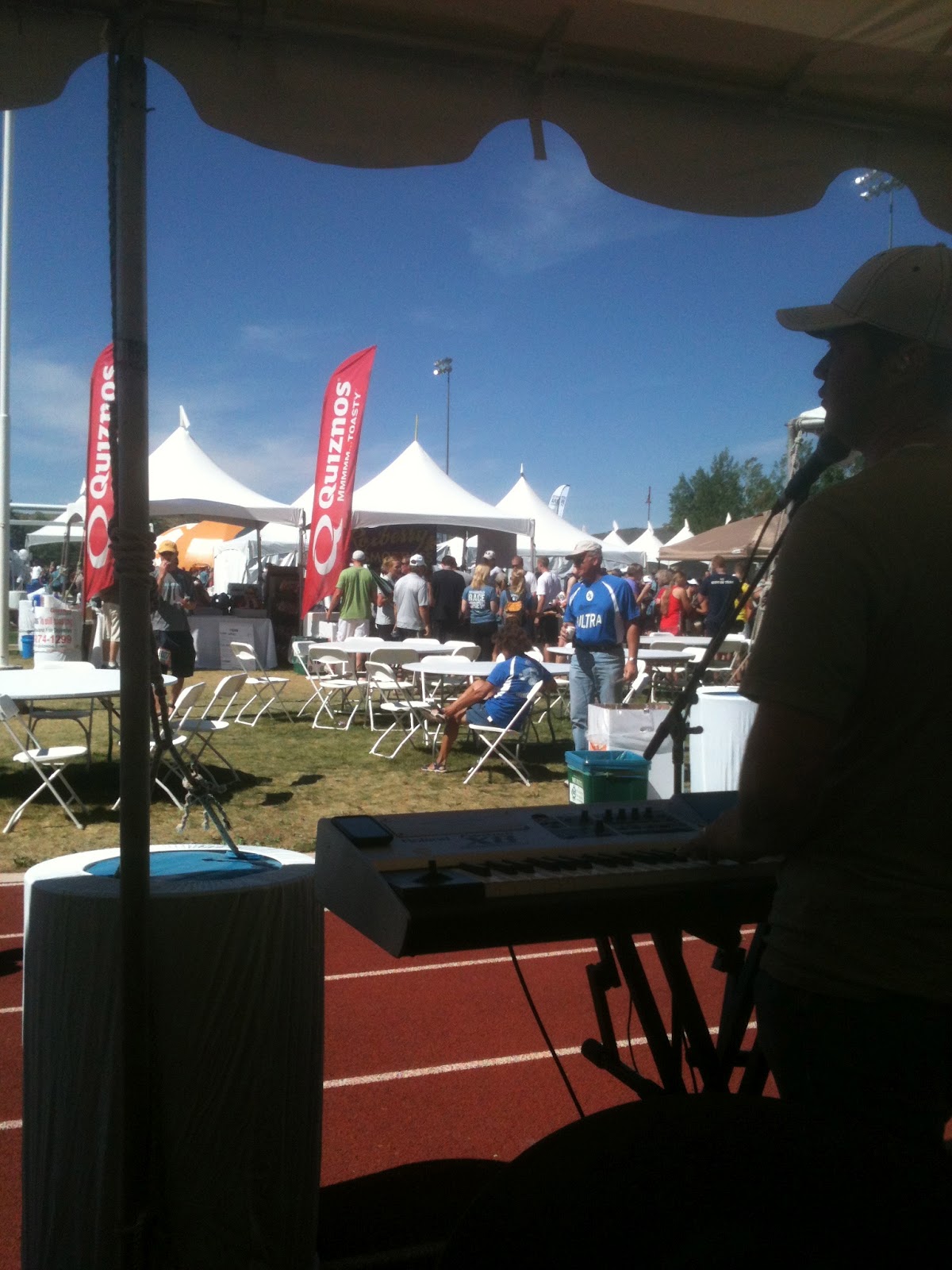
Anyway, fast forward a couple of years, and I played a gig with the band Lokalgrown at the finish line party at the Wasatch Back, part of the Ragnar Relay series.

The view from my seat.
Honestly, there's not much to say about the gig. We were in a tent, had a small but enthusiastic crowd, and played nearly non-stop for four hours. (As a side note, I'm getting more comfortable with my V-Drums, which is a very good thing.) The actual playing was a blast. Very fun gig.

But the best thing about this gig was the people we got to interact with. All these Ragnarians, people who had spent the last thirty or so hours pushing themselves to their physical and mental limits. Some looked absolutely exhausted, and some still had the energy to dance and party it up with us.

One of the hallmarks of most Ragnar teams is crazy outfits, themes and matching shirts. A couple of my favorite sightings from today are, "Half Fast," and "It's my Ragnar and I'll cry if I want to!" We also saw lots of Superman, Wonder Woman, Speedo, cartoon and movie characters, fairies, pink beanies, wigs, Harden's beards, tutus and spandex.

The driver's seat, as it were.
For me, I was very inspired by the people I saw. Some looked like stereotypical athletes, but very many of them were average people - men and women who took the challenge of the race to push themselves out of their everyday life and into a place where they could become better and stronger. Man, I admire that.

I hope I get the chance to run a Ragnar Relay. I know that my physical fitness will benefit, but I also believe that my ability to handle life and music will improve, as well. You and I can both do hard things, and we should.

Run hard. Play harder.

Friday, June 15, 2012

The Weight Room: Summertime is practice time

If you're a junior high or high school music student, it's time for a little heart to heart. Your music teacher absolutely hates the summer break. I don't mean that they aren't looking forward to some vacation time or a chance to work on some other interests. But they absolutely hate the fact that they just spent nine months getting you to a certain point, and you're going to spend the next three months letting a good portion of that progress go to waste.

Sound harsh? It'll get worse. Trust me.

Let's talk physical fitness for a second. Take an average person and put them in a daily training regiment and diet geared toward, say, strength training. If they follow the program on most days of the week, they will make progress toward the goal of gaining strength. If they don't follow the program, they simply don't make progress, right? Wrong.

In actuality, if you're not following the program you're not just failing to make progress, you're actually losing what progress you've made. This is the way the body functions, and it's absolutely the way that music - or any other - skills function, as well.*

Another way to think about it is to imagine a hot air balloon. The balloon has a burner that heats the air inside the balloon. As the air gets hotter, the balloon rises, but as soon as the burner is turned off and the air begins to cool, the balloon starts to fall.

You're either rising or falling. There is no standing still. And once you've fallen, even a little bit, the next bit of energy expended isn't to help you make progress. It's just to get you back to where you were. In the music world, this is called, "maintenance practice." This is the minimum amount and type of practice required simply to keep you from losing the skills you have.

Jascha Heifetz, the legendary violinist, once said, "If I don't practice one day, I know it; two days, the critics know it; three days, the public knows it."

So, with that thought in mind, let's talk about some ways to keep moving forward even when school isn't in session.

First things first. You just have to do it. What's the hardest thing about going to the gym? Going to the gym! Once you get there, it's not a big stretch to complete a workout. The same is true with practice. Once you've got your instrument, music books and pencil out and you're prepared to practice, it's almost impossible not to practice. In the words of the immortal Mary Poppins, "Well begun is half done."

Next, set some goals. Instead of saying, "I'll practice one hour per day," say, "This week I'll get all twelve major scales memorized." And that can be part of a larger goal, like, "Before school starts again, I'll have all the major and minor scales and arpeggios memorized - two octaves - and be able to play through them with a metronome in under four minutes." Now, that's a bunch of goals tied together in one sentence, but you get the idea. Talk about what you'll do, not how much time you'll spend.

Finally, spend more time. And in this case, I really mean spend. Think of it like money (even though it's far more valuable). When you spend a dollar, you expect a certain value back from it, and you only have so many dollars, so you have to spend them carefully and make sure that you're getting value back from your investment. Instead of thinking, "I have to practice for an hour today," say, "I can only give myself an hour of practice time today, so I'm going to get as much out of it as I can."

It's your music, and it's your life. Get everything out if it that you can, and don't waste your opportunities! If nothing else, give yourself the best chance you can. It's up to you.


Happy practicing!

*Because of how my body functions, I absolutely have to spend some time stretching everyday. If I do, I become more flexible. If I don't, I get less flexible, and thus, more prone to injury. There are examples of this concept all over the place, so why do we think it would be any different with music skills?

Thursday, June 14, 2012

Best technology for drummers

Given the rapid increases in technology in the past 100 years, I thought I'd take a stab at listing the top ten technological advances for drummers in the past century. Here are my picks.

1. Hearing protection. This is a no-brainer for me. Of all the critical tools a musician has, the ears are the most sensitive, and they're irreplaceable. And the tools available to protect your hearing while still allowing a full, satisfying musical experience are getting better all the time. You can check some of them out here.

2. Metronomes. I know, I know. You gotta have the pulse inside. Well, consider this tool a pulse-injector if you're willing to spend time with it.

3. Improved thrones. If your sit-down part is comfortable, you won't think a thing about it, but if it's not, you can't think about anything else. Long gigs absolutely require the most comfortable seating.

4. Sticks, brushes and mallets. For me, this is like the tires on cars. It doesn't matter what's under the hood if you can't control it on the street. Not only are there more choices than ever, but the quality and consistency are pretty unbelievable.

5. Pedals. Like sticks and mallets, pedals are the direct link between you and your drums. Especially in the past twenty or so years, I've gone from cursing to praising my footboards.

6. Shell truing machines (think Yamaha's YESS technology). There is nothing worse than a shell that's not round and true. Using the car metaphor, there's nothing worse than a beautiful automobile with an unreliable engine.

7. Head variety and quality. I know some players really dig calfskin, but I'm a huge fan of mylar and kevlar. In addition to sticks, shells and size variations, the heads you choose have a huge impact on how you sound and how the kit feels.

8. Cymbal variety and quality. Almost more than heads, the cymbals you choose will define your sound. I'm amazed every time I see the new releases - and new cymbal companies - that pop up each year. Unique and ever-more-expressive sounds are available to anybody with a little (okay, a lot of) cash.

9. Portable digital recording equipment. Obviously, there are lots of things that can fit into this category, but I'm thinking specifically of things like the Zoom H4N. The ability to record an idea, practice session or gig easily and with great quality is a game-changer.

10. Smart phones, tablets and laptops. Again, this category is huge, but I'm primarily thinking YouTube, educational apps and programs like metronomes, and specialized apps like SoundHound and Garage Band. Almost anywhere you go, the world is literally at your fingertips.

Honorable mention: Drum hardware in general.


What did I leave off the list or put in the wrong place? Let me know in the comments below!

Wednesday, June 13, 2012

"If music be the food..."

Shakespeare wrote, "If music be the food of love, play on..."

But imagine if music really were food. Would you only ever eat one kind of food?* Would you look down on people who liked pasta or vegetables more than a hamburger or fresh fruit? And if somebody really liked a food that you couldn't stand, would you think that person was "weird," and try and fit them into a generational or cultural stereotype? This is why almost no restaurants offer only one food choice - because we'd never eat with one another!

Me? I'm a soda guy. Absolutely love it. On days where I'm very busy or am not thinking about it, I can drink waaaaaay too much soda. And, very literally, that's not good for me. I also like burgers. In fact, if soda and burgers were all a person needed to be healthy, I'd be the the healthiest guy I know.

But I'm not. Even though I know that I need a variety of food, a balanced diet, etc, I don't always make the effort or have the discipline to make it happen. And in very real terms, I suffer (or enjoy) the consequences of my eating and drinking choices.

So, how does this relate to music?

Well, think about how many genres of music exist in the world today. Heck, just turn on a radio and hit the "Scan" button. I live in a mid-sized metro city area (about 1.8 million residents), and scanning the radio for even just a few minutes will net me all sorts of pop, modern and classic rock, jazz, classical, rap, techno, a variety of ethnic styles, country, modern and traditional Christian music, and more**.

But (especially when it's not basketball or college football season), I find myself listening only to the same handful of stations. Why? Because it "tastes good." And it's easy, simple and comfortable. Trying new things, or getting used to new things, can take a great deal of effort and patience, so we don't usually do it unless we have to.

But I've found that if I only ever listen to one kind of music, I start to appreciate and enjoy it less. In the words of Dave Ramsey, "If you eat enough lobster, it will start to taste like soap." And not only that, I start to tolerate other forms of music about as well as a four-year-old who has to eat spinach. Is spinach good for you? Yes. Does any little kid like it? Of course not. But as adults, we know that certain food is good for us, so we work it into our diets, find new ways to appreciate it, and eventually develop a taste for it. (I have one good friend who has actually "trained" herself to despise the taste of chocolate. Strange...)

To get to the point, there are at least two things that a thinking, conscientious music advocate needs to practice:

  1. Get a balanced diet. Seriously. I try to actively listen to jazz for at least a couple of hours per week - even if it's while I'm working or driving - and do the same with classical music. Given the modern age of Pandora, Jango, Spotify, Google Music, iTunes/Genius and the million other music services available, there is no excuse for sticking to one genre of music. And you can have a taste, order an entree, or buy a restaurant. The point is to check out some of the food, er...music that you're missing now. You're guaranteed to find new sounds that suit you, as well as gain a greater appreciation for the stuff you love.
  2. Get over yourself. Seriously (I know, I already used that). I used to hate those snarky, snobby jazz addicts in college. If you couldn't name the trumpet soloist in the first five bars, then, "You obviously don't know music." Who cares that I have a fairly thorough background in keyboard percussion soloists, and most of the jazz cats couldn't tell the difference between a xylophone and a marimba. (Wait...what?! There's a difference?!) Practice the art of open-minded respect that will allow you to recognize the differences in music and preference of such, and educate and strengthen your own musical pursuits. Seriously.
Some of the best musicians in every genre are heavily influenced by musicians from seemingly incongruent genres. I play with a fantastic classical percussionist who is also a double-kick, metal mayhem kit player. And he's awesome at both and loves both.

You're a total person. Get a total music experience.

Happy dieting!

*I'm staying away from the vegetarian/vegan/omnivore debate on purpose. Obviously, that's a bit of a different discussion.

**In some ways, I think that radio is still superior to "owning" a huge music library. Because when a favorite song comes on, it's a surprise and a treat. Sort of like ice cream after dinner at a friend's house.

Tuesday, June 12, 2012

'That Thing You Do' may have had it right

I graduated from high school the same year that the movie, "That Thing You Do," hit the silver screen.

*SPOILER ALERT* (Really?! Is there anyone over the age of twenty who hasn't seen this film?)

When it came out, I was working in a movie theater, so I saw it about six times. Initially, I loved the film because the drummer gets the girl, and that gave me a little glimmer of hope. But as I've progressed through my music career, one scene has come to have more and more meaning.

The scene occurs near the end of the film, when Guy (the main character and drummer in the band) meets one of his music heroes, an old jazz pianist by the name of Del Paxton. Guy has just told Del about his band, and the following conversation ensues (I've taken out some of the dialogue, but you'll get the gist.)

Del: Ain't no way to keep a band together. Bands come and go. But you got to keep on playin' - no matter with who. You guys any good?

Guy: Yeah, man. We got something snappy. Really think we do.

Del: I'm sure you do. But sooner or later, something makes you crazy. Money, women, the road - hell, man, just time.

Guy: Well, we've only been together for four months.

Del: Some bands I've been with, that's four months too long. You keep on playin'...and watch your money. You'll land on your feet. 

Having played in a half dozen or so bands over the past twenty years, I've come to appreciate this approach more and more. I've been fortunate to play with both talented and genuinely good human beings for the most part, but it's true what ol' Del says: sooner or later, something makes you crazy.

In my experience, all of the causes Del lists have caused the breakup of bands, or at least the replacement of members. Time is probably the most common culprit as it eventually exposes everyone's true character, intentions, habits, etc., but money is a close second.

A close friend of mine, an unbelievably good musician, once played in a band that broke up two weeks before a very high-paying battle of bands because they couldn't agree on what they'd do with the money if they won. Yep. They broke up over money they didn't even have.

Beyond that, though, I've found that things are usually pretty good in a band until you start making some real money. There will be fights over who's doing more work, writing more of the material, booking the gigs and who has to spend the most on gear (drummers, of course). And if you get picked up by a record label, you have to deal with who gets the royalties, how the funds are split, who the manager is going to be, and much, much more.

There's a book that can help shed some light on it that I highly recommend. It's a little outdated at this point, but will give you a very clear, very accurate vision of how convoluted things can get in the music industry.

Check out the book here. 

I'd also recommend that you read some of the books about the band U2, and learn a thing or two. In my opinion, they did it right. Why do I think that? Because they're in their FIFTH DECADE (YES - FORTY-EIGHT YEARS) of productivity and worldwide relevance. Compare this to the average one-hit wonder, and you have to think they found a magic formula of some kind, and part of that is an absolute commitment to share all the money equally for everything - gigs, sales, royalties, merchandise - everything.

Honestly, this topic (and all the related topics we should also cover) could take up a hundred years on a blog all by itself. But, for starters, let me offer just a couple of pieces of advice to get through the ups and downs of bands.

You got to keep playin'. Del Paxton nails this one, for sure. Always view yourself as an independent musician, even when you're committed to a band. Eventually the band will move on, and you'll still be a musician. Don't let the band's identity become your identity. Most importantly, you should always have some aims and goals that will last, and be prepared for the band to be gone. What would you do if they broke up today? Who and what would you be? What would keep you working on your music? I'm not saying you shouldn't be dedicated to the band, but be dedicated to yourself, too.

Watch your money. This will seem less important when you're not making any, but the instant the first dollar lands, you'll have a major problem if you don't have a major plan. How will the money be split, and do you all agree about it? Who will do the extra work involved in setting up and running the sound system? Will they get paid for it? How will you fund your band in terms of equipment, gas money, your individual instrument upkeep, etc? Does the drummer get more for cartage?

Try to think about every possible problem or contention, and agree on how it will be handled. When problems arise, talk about it openly and honestly as soon as possible, and don't stop talking until you all agree. And, as I've mentioned on another post, have a plan for saving some of your dough.

Give it everything you can, but not more than that. Keep your music - and especially bands - in their proper place in your life. There's definitely a time and place to focus on just one thing, but be careful about putting a job, relationship, school or other opportunities at risk. Especially with a band that's starting to go somewhere, it can be very tempting to put all of your eggs in that one basket. I always try to ask myself, "What if this thing blows up today? What will I do?"

Because - trust me on this one - anything in life can change in a heartbeat, and bands are especially prone to blowing up in an instant.

More on bands to come. And if you've had some experience, share it with us in the comments below.

Happy drumming!


Saturday, June 9, 2012

Transitioning from acoustic drums to Roland's TD-9KX2-S

First gig on the new kit.
I've been playing drums for 23 years as of this fall. I've played all of those years on acoustic instruments.* So earlier this year when one of the bands I play for wanted me to go electric, I was skeptical, to say the least.

In this particular case, the goal was twofold. First, we wanted to reduce stage noise (we also transitioned to in-ear monitoring), and second, we wanted to have more sound options at the touch of a button. This particular band is very show-oriented - an entertainment band that primarily plays corporate and community events, with the occasional wedding.

About two months ago I gave in, bit the bullet and dropped two grand on a closeout model of the Roland TD-9KX2-S. Since then, I have played about 6-7 gigs on the kit, and it's been quite the adjustment. To achieve the goals of the band and also to get a full perspective, I'm using the kit as-is, straight out of the box. No substitutions (like cymbals or snare drums), no additions, and no modifications.

Still getting used to how it looks on stage.

To be fair, I wanted to get a few gigs into the new arrangement before I started blogging about it, so I've waited until now. At this point I feel like I'm starting to understand some of the strengths and weaknesses, so I'm going to be sharing my observations periodically and asking for feedback from other musicians.

Just to get started, here are two quick observations:


  • It's not the real thing. It's just not. After discussions with other players who use both acoustic and electric instruments, I've come to the conclusion that when I play V-Drums, I'm no longer a "drummer." I'm an, "electronic musician." I still play the role of drummer, but I have to realize that I'm not playing drums. I'm essentially playing a computer with a drum-like interface. 
  • Because it's not the real thing, the player is limited by the programming and the capabilities of the hardware. With real acoustic drums, you're limited by physics. One great example of this is the playing of shells, stick clicks, ping shots and cymbal harmonics. The programming simply will not support the natural acoustic responses of wood, metal and mylar.
My load out "stack."
If you have opinions, observations or suggestions for those of us venturing into the electronic side of drumming, feel free to share below. 

More to come...

*Okay, okay. I did own an earlier Roland V-kit for about a year, but it was used exclusively in a teaching studio where volume was a major issue. I think I did a one-song recording project on it for a friend, but that was it. All other gigs were on acoustic drums. I was so non-plussed with the kit that I sold it as soon as I moved out of that studio.

Interview on "Teach America Rhythm"

I've been neglecting the blog lately - due mostly to insane gig/rehearsal schedule - but I promise I've got some great stuff coming. 

A while back I was interviewed by Craig Stluka of the website Teach America Rhythm, and he let me know today that my page is live. There is a lot of great stuff on the website now, and he has much more to come in the near future. If you want to go straight to my page and hear the interview, you can find it here.

For all of us that have ventured online to both share and find information about music and drumming, it's nice to know that there are resources like this available.

Thanks again, Craig!

Why musicians should watch the big game (Seriously!)

Photo by  Ameer Basheer  on  Unsplash Here we are, about to watch another televised wrestling match over who puts a football on one en...